


Judge Issues Blistering Rebuke of Grendell Orders
“I use the word ‘negotiate’ broadly here, to include threats to put people in jail if they do not vote for an agreement.” – Judge John J. Lohn
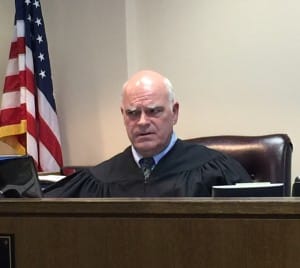
A visiting judge has rebuked Geauga County Probate Court Judge Tim Grendell’s actions against two Chester Township trustees over their refusal to give up control and oversight of township park land.
Retired Medina County Probate Court Judge John J. Lohn found Grendell violated the separation of powers doctrine when he issued two judgment entries in September 2016 ordering a civil and criminal investigation into whether trustees Ken Radtke and Mike Petruziello broke the law in voting on Aug. 18, 2016, not to enter into a new agreement with the Chester Township Park District Board of Commissioners for management of Parkside Park.
Lohn had been assigned to hear and review Master Commissioner Mary Jane Trapp’s investigative report after Radtke filed an affidavit asking Ohio Supreme Court Chief Justice Maureen O’Conner to remove Grendell from the case because of perceived bias, prejudice and partiality. Grendell eventually agreed to step down.
“The September 2016 entries violate the separation of powers doctrine and are premised upon an improper judicial investigation,” Lohn said in a strongly worded 16-page order, filed Feb. 2. “I will not conduct further proceedings.”
He set aside Trapp’s 22-page report containing her interim findings — which he heard during a 90-minute hearing on Jan. 6 — and discharged her from her commission.
Lohn said Grendell justified his orders on non-binding judicial language — language that Trapp, a former appellate court judge on the 11th District Court of Appeals, agreed was non-binding editorial during the Jan. 6 hearing — from an April 2016 Ohio Supreme Court decision that he flowered into law; namely, that a probate court’s authority vis-à-vis park districts “surely includes the ability to issue orders to enforce the entry creating the park district, including orders that impose duties on those interring with the park district’s purposes.”
But the Supreme Court decision did not authorize Grendell to threaten Radtke and Petruziello, and their attorneys, with jail time, fines or civil judgments, Lohn said.
“Under Judge Grendell’s view of his jurisdiction, a property owner who has a yard sale that slows traffic to and from a park, or a contractor who improperly installs a swing set or a citizen who sends an email criticizing a park commissioner — each could be brought before the probate court to face contempt charges for ‘interfering with the park district’s purposes,’” he added.
From the township trustees’ standpoint, Lohn said, it was important for the 11th District to determine the limits of a probate court’s authority over them “as a board and as persons.”
“I am firmly convinced the court’s jurisdiction does not extend to non-parties such as Mr. Radtke and Mr. Petruziello,” he added.
“In my view the jurisdiction of the probate court is limited to the express power to appoint and remove park commissioners and to dissolve a park district; and the implied power to investigate park operations to determine if a park commissioner should be removed,” said Lohn.
Separation of Powers
Lohn found Grendell’s September 2016 orders were not directed to Chester Township or the board of trustees as a legislative body. The orders also did not mention Trustee Bud Kinney, who voted to approve the new agreement, he noted.
“Rather, the September 2016 orders threaten Trustees Radtke and Petruziello personally,” Lohn said.
The judge said Grendell targeted the two trustees for rejecting the agreement, yet he never conducted a hearing at which any evidence was presented about their Aug. 18 vote.
In fact, there were no court hearings held between Aug. 9 and the dates the September orders were issued, said Lohn, making them the “product of a highly irregular and erroneous process.”
“The doctrine of separation of powers protects a legislative body from judicial activism and overreach. This doctrine is fundamental to our tripartite system, where each department of government is independent but each works in comity with the others,” Lohn said. “This doctrine is part of the checks and balances inherent in Ohio’s constitution.”
Radtke and Petruziello had done nothing to subject themselves to the jurisdiction of the probate court as individuals, he found.
“But when Mr. Radtke and Mr. Petruziello used their legislative prerogative to vote against the new agreement, it triggered (Grendell) to issue the September 2016 orders against them,” said Lohn, noting each trustee was “free to vote for or against the new agreement according to their own discretion and considered judgment.”
He added, “Township trustees answer to their constituents, not the probate court.”
The judge concluded the doctrine of the separation of legislative and judicial powers prevented him from enforcing Grendell’s September orders.
Grendell’s action likely violated the separation of executive and judicial powers as well, he said.
Park commissioners have operational control and oversight of a park district — an executive function, Lohn said.
“And as seen here, (Grendell) acted unilaterally — like an executive — without waiting for a motion from the park commissioners, without notice to the parties and without giving Mr. Radtke or Mr. Petruziello or their attorneys an opportunity to be heard,” he said, adding courts cannot dictate how other branches of government perform the work that is their public duty to accomplish.
In addition, Lohn found Grendell’s “judicial influence” over the Chester Township Park District began in 2014, when he first appointed Trapp to determine if it was operating legally and if park funds had been mismanaged.
As part of her assignment, she was instructed to broker a new management agreement between trustees and park commissioners for Parkside Park, a role she played until last August.
“The probate court has oversight over park commissioners. The board of commissioners has oversight over the park district. It does not follow that because the park board has authority to negotiate agreements and because the probate court appoints the members of the park board, the probate court can negotiate agreements for the park board,” Lohn said. “I use the word ‘negotiate’ broadly here, to include threats to put people in jail if they do not vote for an agreement.”
In addition, he pointed out every problem mentioned in Trapp’s 220-page report, issued in 2014, should have been “foreseen, prevented or corrected” by the park commissioners and their administrators “through the exercise of due diligence.”
Despite his criticism of Grendell’s actions, Lohn reiterated it would be up to the 11th District to identify limits and exceptions to the probate court’s jurisdiction.
Yet, he concluded Grendell’s “incursion” into the legislative function was “clearly prohibited,” and his “usurpation of executive authority” probably was prohibited.
Other Findings
In addition to finding Grendell’s orders unconstitutional and unlawful, Lohn said Grendell taxed Trapp’s fees as court costs and approved them “prospectively and without limitation; before they were earned, before they were submitted and before the parties could review and challenge them.”
He also found Trapp did not follow the mandatory process set forth in the statute under which she was appointed, and should have disqualified herself from undertaking the assignment because the roles of “witness, investigator and adjudicator were impermissibly combined” in the September orders.
In addition, Lohn said the question of whether Radtke or Petruziello committed the crime of retaliation should have been referred to the county prosecutor’s office.
“A master commissioner’s opinion on this subject is conjectural and of no value to these proceedings,” he said.
Also irrelevant to the proceedings is whether the individual park commissioners or Grendell’s civil rights were violated.
“Moreover, the judge cannot ethically so instruct the master commissioner because the master commissioner’s legal opinion on this subject would have value only to the judge personally,” Lohn said. “A judge may not use his office for personal gain … If a judge wants to know if his civil rights were violated, he must hire a lawyer on his own expense to get a definitive answer. A master commissioner cannot act as his private counsel.”
Editor’s Note:
The Geauga County Maple Leaf emailed township trustees, park commissioners Joe Weiss and Clay Lawrence, and Judge Grendell inviting them to email any comments on Judge Lohn’s order. Trustees Ken Radtke and Bud Kinney declined comment, and Trustee Mike Petruziello said he would respond with comments, if any, on Friday. Weiss indicated he would issue a statement on Friday. Lawrence indicated he would respond later today or this evening.
Grendell did not reply with any comment. However, Kim Laurie, budget/fiscal director and county liaison for the Geauga County Probate/Juvenile Court, replied with the following written comments:
Retired Judge Lohn’s ruling directly contradicts the decision rendered by all seven Ohio Supreme Court Justices, as well as the opinion advocated by eighteen of Ohio’s most experienced Probate judges.
Judge Grendell relied upon and followed the Ohio Supreme Court’s unanimous 2016 ruling, as he is legally and ethically required to do.”
In a subsequent email, Laurie provided additional clarification to her earlier comments:
And just to provide some more clarification, Judge Grendell has a duty to ensure that prior Judges’ orders are upheld, including that of Judge Lavrich which created the Chester Township Park District in 1984, as explained by the Ohio Supreme Court’s unanimous decision. The investigations were conducted by an unbiased court appointed Master Commissioner, as specifically provided for by Ohio law, simply to determine if the actions by the township trustees interfered with that order. Such judicial prevention of interference with Judge Lavrich’s order is specifically permitted by Ohio law, again as explained by the Ohio Supreme Court’s unanimous decision.
There was no separation of powers violation. Judge Grendell directed the Master Commissioner to determine whether the township trustees interfered with, or frustrated the purpose of Judge Lavrich’s Probate Court order that created the township park district, and he relied upon notifications from the Master Commissioner as well as statements made in court by an assistant prosecutor. There were no out of court investigations conducted.
Finally, retired Judge Lohn erroneously interpreted Judge Grendell’s view of his jurisdiction regarding actions interfering with the park district’s purposes to include trivial matters such as a yard sale that slows traffic to and from a park, an improperly installed swing set, or an email critical of a park commissioner. Judge Grendell’s jurisdiction was very clearly defined in the Ohio Supreme Court’s unanimous decision which, in fact, recognized that actions by Township Trustees which directly interfere with Judge Lavrich’s original order is proper jurisdiction for the Probate Court judge, as these actions would effectually terminate the park district’s operation of the only current park within the district.


